
 Log into your account
 Register


Imagine it’s the 16th century, and you are in the bustling port of London. Ships loaded with fabrics are arriving from Genoa, flooding the market with bright blue fustian, which has gained immense popularity lately. You refer to it as “jeans,” mispronouncing the name of its origin city, where this special fabric has also caught the attention of renowned artists and artisans. Let’s explore how indigo-dyed fustian has influenced the European textile industry in the 16th and 17th centuries.
The role of Chieri
In our previous chapter, we saw that Chieri is one of the cities that claim to be the birthplace of jeans. The production of fustian was officially established there in 1347. A tax declaration from 1366 also indicates that a master craftsman was present in the Piedmont city during the second half of the 14th century. Additionally, Chieri’s fustian masters are mentioned in a Turinese document from 1403. However, a guild to protect this craft was not formed until 1482, when the Duke of Savoy recognized it, which was much later than similar guilds established in other parts of Italy in previous centuries. The Chieri guild was required as entrepreneurs began to understand the need for standardized manufacturing practices to effectively meet market demands and growing competition.
Before the rise of fustian production in Chieri, this fabric was primarily made in Milan and other nearby textile centers. However, the production crisis in Milan between 1338 and 1347, along with Chieri’s ability to negotiate favorable trade agreements that included toll privileges and exemptions along the road connecting Piedmont to central Europe, enabled fustian manufacturing to thrive there. Most importantly, Chieri was better at interpreting market needs, producing low- to medium-quality, affordable fabrics for a large share of the population.
Chieri’s fustian was characterized by its fiber quality, weaving technique, and twill pattern. While specific details about earlier qualities remain uncertain, it is known that 17th-century fustian featured a 2x1 twill. The city produced several different types of fustian: “fustanei albi,” which were white and of the finest quality; “fustanei albi et crudi,” which were raw and unbleached; “fustanei leviu,” which were lightweight and inexpensive; “fustanei forti,” which were heavyweight and of good quality; “fustaneis magne sortis,” which were of high quality; “fustanei mediocri” or “mezani,” which were of medium quality; and “fustanei nigri,” which were dyed with woad.
Chieri maintained its status as the leading textile production hub in Piedmont until 1712, as it was the only place in the region capable of processing raw cotton and yarn. Its decline began when other weaving centers emerged in the area, and the city struggled to modernize its operations.
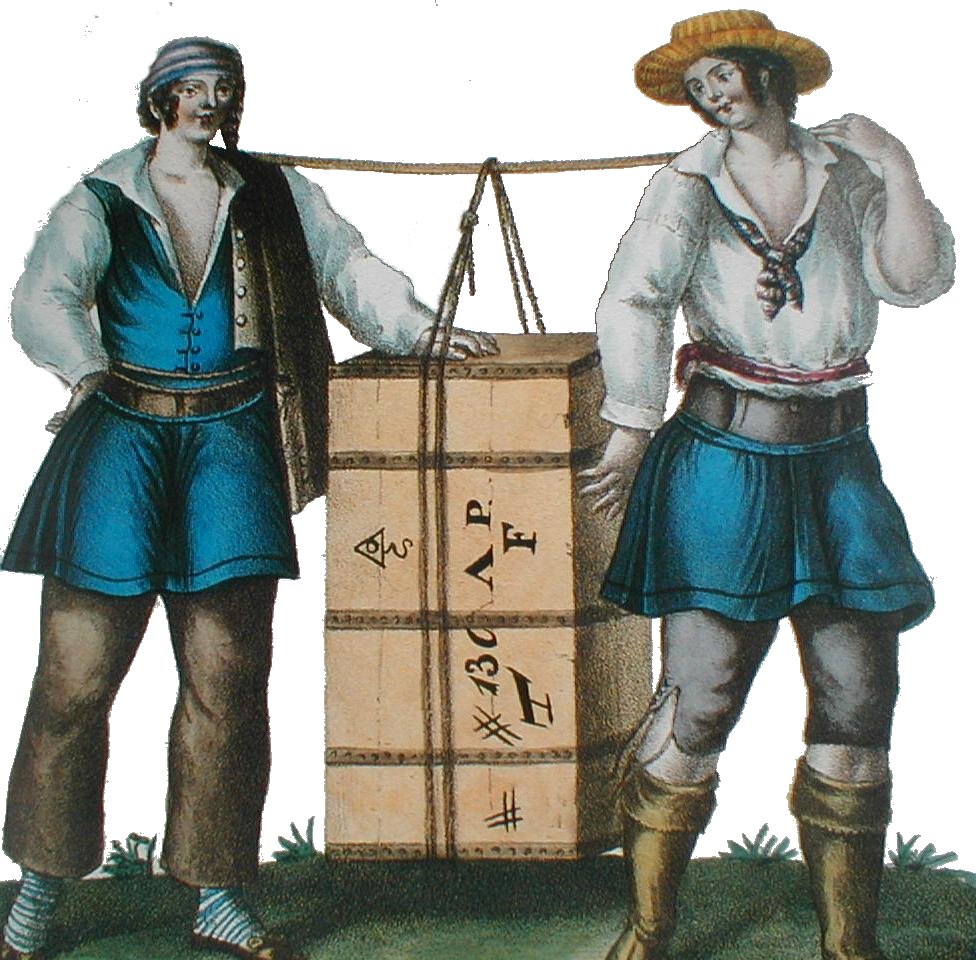
A. Pittaluga, Porters from Bergamo at the port of Genoa, Duché de Gênes, Paris.
Some data about Chieri’s fustian production
Textile workers in Chieri were responsible for transforming yarns into woven goods. At the same time, merchants could rely on a flexible workforce, as the city’s main activity remained agriculture. Farming provided essential support for workers, and textile operations offered additional income during times when agricultural work was scarce. Data indicate that in the second half of the 16th century, only 4% of Chieri’s weavers were professionals. The specialized weavers were full-time employees, but they were primarily foreigners recruited from Milan to produce fustian. Additionally, some were seasonal workers who stepped in to replace local laborers when they were busy with farming.
Historian Luciano Allegra estimates that Chieri produced between 50,000 and 60,000 pieces of fustian, which suggests the city had around 1,500 to 1,800 weavers, comprising about half of the urban workforce. Other sources claim that by 1560, Chieri’s annual production of fustian reached 100,000 pieces, comparable to Ulm’s output during the same period. Approximately 6,000 to 7,000 bales of this fustian were exported each year via the port of Genoa. In the 16th century, Piedmontese fustian was sold in Lyon for just over half the price of German cotton textiles. However, it’s worth noting that conducting such textile operations was particularly challenging, as they depended on overseas imports of raw materials and lacked a stable domestic market. This required positioning products in highly competitive European markets.
About cotton import
Venice historically imported high-quality cotton to support the limited fine urban textile production. In contrast, lesser varieties of Turkish, Sicilian, and Maltese cotton, brought in through Genoa, fueled rural manufacturing, supporting the emergence of new centers of cotton textile production in the rural areas of Lombardy and Savoy during the 15th century. Meanwhile, Genoese merchants established cotton weaving districts in Piedmont and Liguria. This region became known for producing heavy fabrics using inexpensive cotton imported through the port of Genoa, along with local flax and hemp.
In the 16th century, both luxurious fabrics crafted in Milan and Cremona and affordable fustian produced in Lombardy and the Genoa region—famous for its heavy jeans fabrics—began to gain markets north of the Alps. These textiles competed directly with German fustian and other emerging centers throughout Europe that sought to imitate the refined styles of Italian textiles. Additionally, large quantities of these fabrics were shipped to England and Spain, with a portion being re-exported in transatlantic trade.
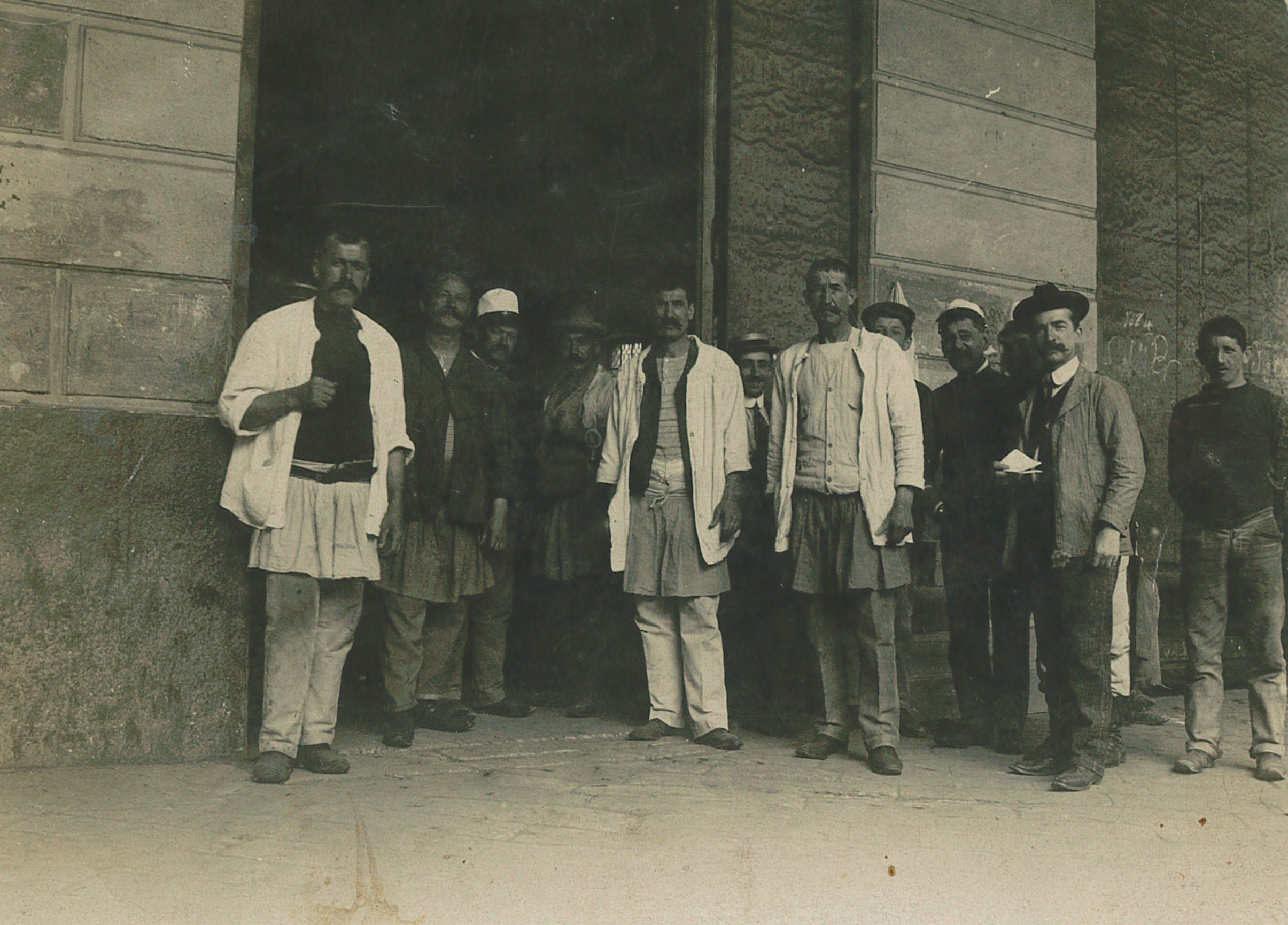
Genoese portworkers.
The birth of jeans fabrics
In the 16th century, Genoese fustian emerged in Europe for its average quality, durability, and affordable price. Initially, these features were seen as indicators of a decline in local manufacturing, but they ultimately contributed to its long-lasting success. This fabric was made with cotton yarns and featured an indigo-dyed warp instead of the more common woad. Although indigo was used in Genoa as early as 1140, it did not become widely popular until the second half of the 16th century. This increase in use can be attributed to expanded trade with Eastern countries, facilitated by the strategic role of the port of Genoa in both imports and exports, as well as the new sea route opened by Vasco da Gama. Sailors and dock workers used fustian to make sails, cover goods, and create nearly indestructible workwear, which was practical for their needs. The fabric’s blue color also helped hide stains.
From the 12th century onward, England became an important player in the fustian trade, driven by steadily growing domestic demand for everyday fabrics. By the 16th and 17th centuries, this demand surged, with fabrics from Genoa and Ulm becoming particularly popular. While German fabrics were often considered higher quality, those from Genoa were more affordable and durable enough for everyday use, making them the preferred choice for many consumers.
Fustian manufacturing techniques varied across cities, leading to fabrics being named after their places of origin. However, names were often misspelled in inventories. By the late 16th century, the terms “jean” or “jeans,” sometimes appearing as “jeanes,” “geanes,” or “jeane,” began to surface in English inventories to identify fustian imported from Genoa. For instance, a 1577 inventory by Thomas Pasmore from Richmond lists two yards of “whitt jeane,” while a 1578 inventory notes various popular fustian fabrics based on origin, including “whit holme fustian” and “white holmes” from Ulm, “fustion in aples” from Naples, and “jeanes fustian” from Genoa. The name “jeans” is believed to have derived from a twist on the French name for Genoa, “Gênes.” Therefore, when you hear the term “blue jeans,” it traces back to “bleu de Gênes,” referring to the fabric’s signature color and birthplace.
The increasing demand for fustian in England also stimulated local manufacturing. By the early 17th century, Genoese fustian was slightly more expensive than fabrics produced in areas like Lancashire, particularly around Manchester. However, for those seeking quality at a reasonable price, Genoese fustian remained the best option for a nice-looking, durable fabric. Its popularity grew to the point that the name began to be applied to similar fabrics, not just those from Genoa. The rise of fabric production in Lancashire also popularized jean fabric in the United States, which we will discuss further in the third chapter of the history of jeans.
Fun fact: where does the word fustian come from?
The exact origin of the word “fustian” is uncertain. Still, there are a couple of plausible theories that may explain its roots. One possibility is that it comes from the Latin adjective “fustaneum,” which refers to the fiber used to produce a specific type of cloth, namely cotton. This term is derived from “fustis,” meaning “trunk” or “wood.” Therefore, fustian could imply something akin to “shrub-like.”
Another possibility is that the term fustian is linked to al-Fustāt, the first urban settlement that later became Cairo. It is believed that a cloth produced using a particular weaving technique was imported from this region. Al-Fustāt began as a military camp established by General Amr in 641 while serving the caliph Omar in Egypt, designed to keep soldiers away from the distractions of Alexandria. The prestige associated with an exceptional tent made from this cloth may have contributed to the term’s widespread usage.

Denim and art
Art plays a significant role in helping us understand the importance of blue fustian in Genoese society. From 1538 to the end of the 17th century, Teramo Piaggio, along with his coworkers and other Genoese artists, was commissioned to create a series of canvases for the Benedictine abbey of San Nicolò del Boschetto, now known as the Passion canvases. These fourteen linen canvases, painted with ceruse, depict the Passion of Christ and were originally displayed during Holy Week celebrations. Today, they are housed in the Diocesan Museum of Genoa. One of their main features is the blue background, reminiscent of modern denim, while the style was influenced by artists such as Raffaello and, notably, Albrecht Dürer, whose engravings served as references.
Blue fabrics are also featured in the works of various Flemish, French, Italian, and Spanish painters. However, the most renowned portrayals of denim-like clothing date to the 17th century and were created by an unknown Northern Italian artist, dubbed the Master of the Blue Jeans for his distinctive paintings. Drawing inspiration from Caravaggio’s dark palette, he depicted the humble, everyday lives of individuals in the region, many of whom wore blue fabric that faded in certain areas, resembling the look of our contemporary jeans.
Finally, nativity figures dressed in Genoese fustian date back to the latter half of the 18th century and primarily represent shepherds and panhandlers. These figures are the earliest examples of denim-like clothing, even in miniature form, which have endured to the present day.
