 Log into your account
 Register



Have you ever heard of Savile Row? This slender street, nestled in the elegant Mayfair district of London, stands as a beacon of sartorial excellence, craftsmanship, and style. We are honored to collaborate with Men’s File by supplying denim fabric for a special blazer crafted by Dege & Skinner, a distinguished bespoke tailoring house in the area. This partnership exemplifies the versatility of denim and its remarkable transformation from humble workwear to a symbol of luxury and refinement.
How Savile Row became the symbol of bespoke tailoring
The history of London’s Savile Row reflects the evolution of society, beginning as a center for bespoke tailoring at the end of the 18th century. As Britain experienced growing prosperity, job opportunities in leisure and luxury industries expanded, prompting the opening of more stores.
Savile Row, as we know it today, was established in the 1730s during the development of the Burlington Estate. It was named after Lady Dorothy Savile, the wife of the 3rd Earl of Burlington, who owned the land. The street became a fashionable residential area for military officers and statesmen, attracting many menswear tailors. By the turn of the century, this influx of tailors had solidified the neighborhood’s reputation.
Savile Row in the 20th century
Until the end of the Second World War, Savile Row was a stronghold of bespoke menswear. After the war, a new generation of garment makers revitalized the street with fresh approaches to tailoring. In 1949, fashion designer Hardy Amies opened his fashion house at number 14, offering haute couture for both men and women. He became famously known as the dressmaker of HM Queen Elizabeth II.
The Peacock Revolution of the 1960s brought further innovation to Savile Row with its colorful and flamboyant designs. Tailor Tommy Nutter, who opened his store with his brother David at number 35a in 1969, played a significant role in reinventing the Savile Row suit. Working with master cutter Edward Sexton, they infused a sense of modernity into the street, attracting a younger clientele with bold, avant-garde creations. Notably, Mick and Bianca Jagger wore Nutter’s suits on their wedding day in 1971, and three out of the four Beatles donned his bespoke suits for the cover of their “Abbey Road” album.
Savile Row today
For over 200 years, many renowned tailoring houses on Savile Row have dressed royals, music icons, politicians like Sir Winston Churchill, international figures such as Gianni Agnelli and Aga Khan, and Hollywood stars like Cary Grant and Fred Astaire. Most garments produced there are bespoke, meaning they are unique items tailored to the customer’s measurements and specifications, requiring several fittings and skilled artisans.
While some businesses have been around for centuries, others have joined recently, each with its distinctive style and clientele. However, it is their collective presence that has established Savile Row’s reputation for bespoke craftsmanship, which remains strong today. As Savile Row moves into the 21st century, it continues to be a bastion of tradition and craftsmanship, attracting a global clientele seeking the epitome of bespoke luxury. The street has consistently adapted to ever-changing tastes and needs while preserving its core values.
Did you know that…
…many journeymen working under the direction of a master tailor came from working-class or migrant backgrounds? The skills required to be a tailor, such as a steady hand and attention to detail, were not highly rewarded centuries ago. As a result, these tailors often worked long hours for little pay.
…these tailors formed a close-knit community that developed its own language? They referred to “Clapham Junction” as a draft with many alterations and additions, while a “pig” was an unclaimed garment. If you were “on the cod,” it meant you had gone out drinking. Some Savile Row slang is still used today.
…The Beatles’ final public performance took place on Savile Row in January 1969? They played on the rooftop of their record label, Apple Corps.
…allegedly, Soviet spies used the tailor shops on Savile Row as meeting points during the Cold War? There are stories of espionage surrounding the street, highlighting its unwitting role in geopolitical intrigues.
…Alexander McQueen, renowned for his progressive designs, began his career on Savile Row? This showcases the street’s ability to nurture diverse talents, including Ozwald Boateng, who is celebrated for his modern take on tailoring with bold colors and patterns.
Dege & Skinner, a 160-year-old story
J. Dege & Sons, trading as “Dege & Skinner,” is one of the two remaining family-owned bespoke tailoring houses on Savile Row. It was established in 1865 by Jacob Dege, a German journeyman tailor who moved to England in 1855 in search of fortune. The original location was at 3 Conduit Street, London, W.1.
Jacob Dege had a large family, and his three sons attended Merchant Taylors’ School in Charterhouse Square. As business flourished, the two elder sons began working alongside their father. However, the youngest son, Arthur, did not have a place in the family business, which prompted him to start his own venture with a school friend, William George Skinner (Bill), whose family were tailors on Jermyn Street. They named their business “Arthur Dege & Skinner,” which began trading from Grafton Street in central London in 1900.
Initially, the business showed promise, but tragedy struck when both of Arthur’s elder brothers died unexpectedly. Additionally, Bill was killed in 1913 while riding a horse in Richmond Park at the age of 40, leaving behind a widow and two young sons. Jacob Dege paid for the education of Tim (also named William George), who was 12 years old when Bill died. Tim became an apprentice at J. Dege & Sons in 1916. When the First World War began, Arthur Dege & Skinner had closed, and Arthur had joined his father at J. Dege & Sons. Due to rising anti-German sentiment in Britain, Jacob stepped down from his chairmanship in 1917, and J. Dege & Sons Ltd became a private limited company.
A family business for the royal family and military tailoring
During this time, Tim Skinner quickly developed his tailoring skills and gained the respect of his garment makers, advocating for proper wages for them. He held his first trunk show in Cheltenham in 1928 and successfully expanded J. Dege & Sons into the North of England and Scotland. In 1939, the company acquired Wilkinson & Son, robe makers to HM King George VI, and two years later opened branches at the military garrisons of Aldershot and Catterick Camp. The production of military uniforms became essential for the company’s survival. In 1947, with support from his wife’s stepfather and mother-in-law, Tim acquired J. Dege & Sons Ltd.
Tim’s son, Michael Skinner, joined the business in 1953, coinciding with the coronation of Elizabeth II as Queen of England. During the coronation ceremony at Westminster Abbey in June, Michael, his father, and Arthur’s son, John Dege, helped dress the peers of the realm, including Sir Winston Churchill. Dege & Skinner is proud to hold Royal Warrants of Appointment from HM Queen Elizabeth II, the HM Sultan of Oman, and the HM King of Bahrain.
In the 1960s, Michael Skinner began expanding the business with its first trunk show in the United States and by acquiring Rogers John Jones, a specialist in military tailoring. The company has created uniforms for royal weddings, including the uniform HRH Prince Harry wore at his wedding to Meghan Markle.
In 2000, in recognition of his family’s century-long contribution, Michael re-established the trading name “Dege & Skinner.” In 2015, the company celebrated its 150th anniversary under the leadership of Michael’s son, William Skinner, who is the fifth generation of his family to have joined the business and has been managing director since 2001.
A special denim blazer for the 160th anniversary of Dege & Skinner
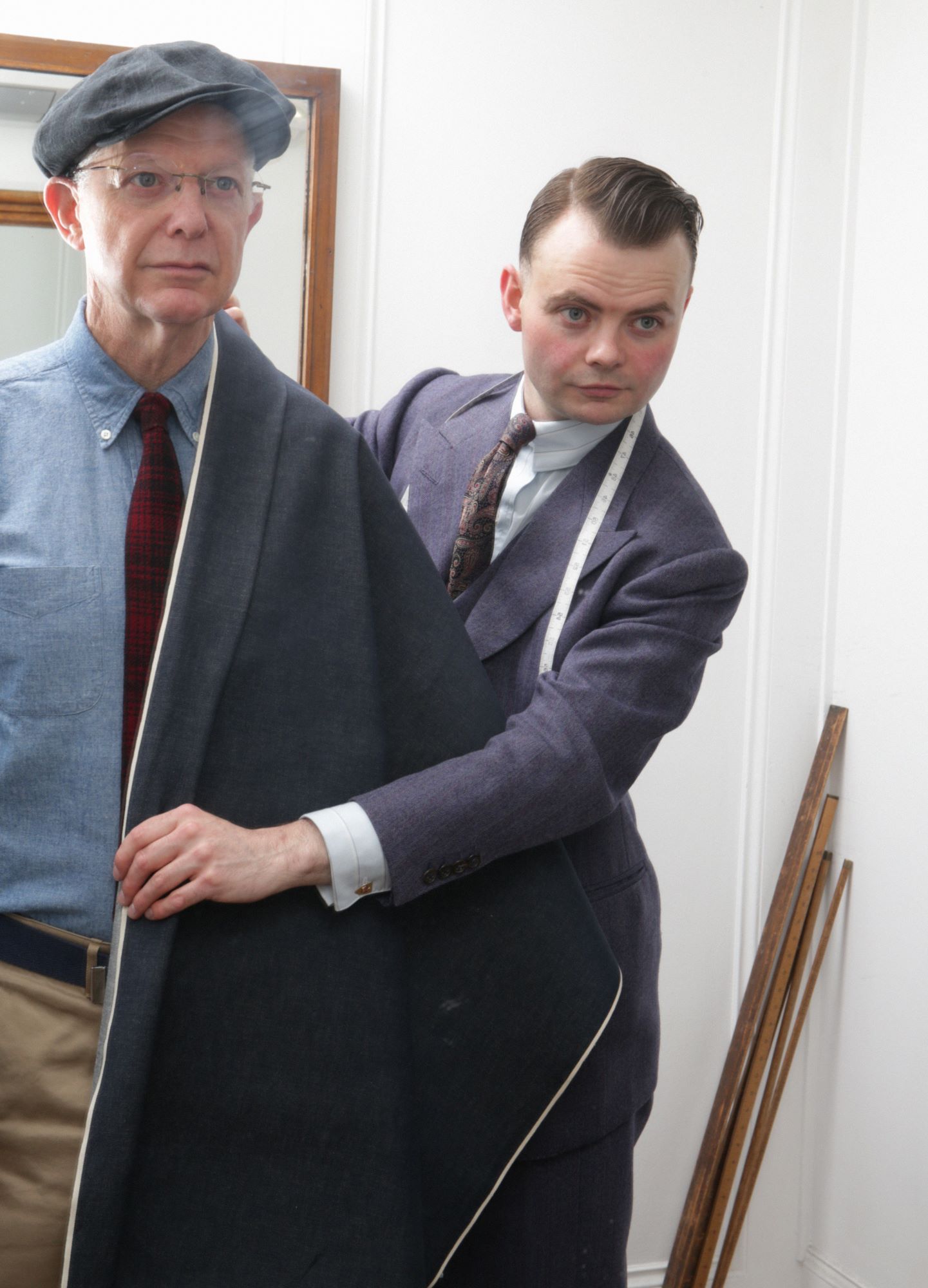
We are honored to blend our denim heritage with the remarkable history of Savile Row as we join Men’s File in celebrating the 160th anniversary of Dege & Skinner! For this occasion, they have created a special blazer using our lightweight selvedge denim—a fabric that fuses craftsmanship and tradition with innovation and modern taste, much like the tailoring at Savile Row.
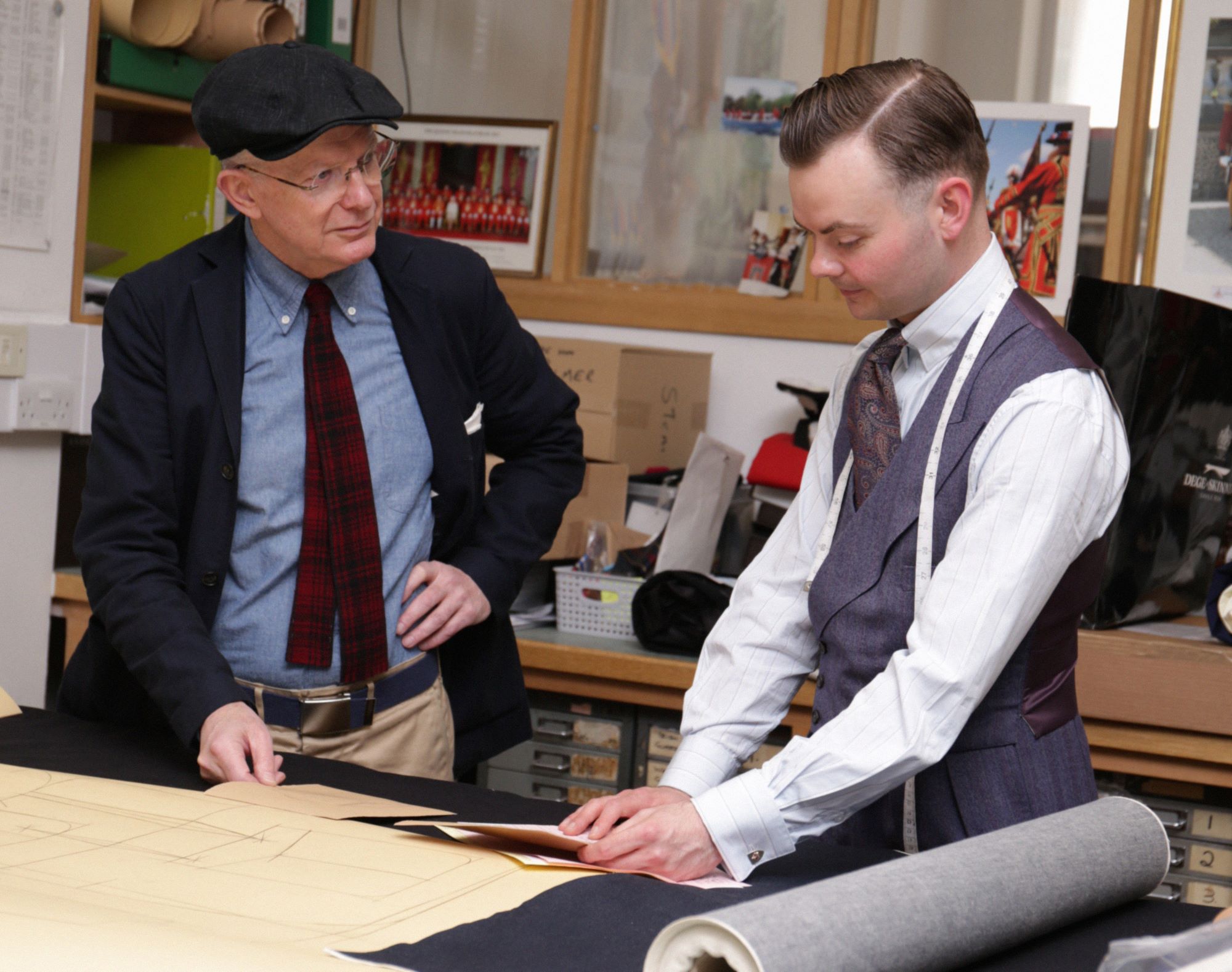
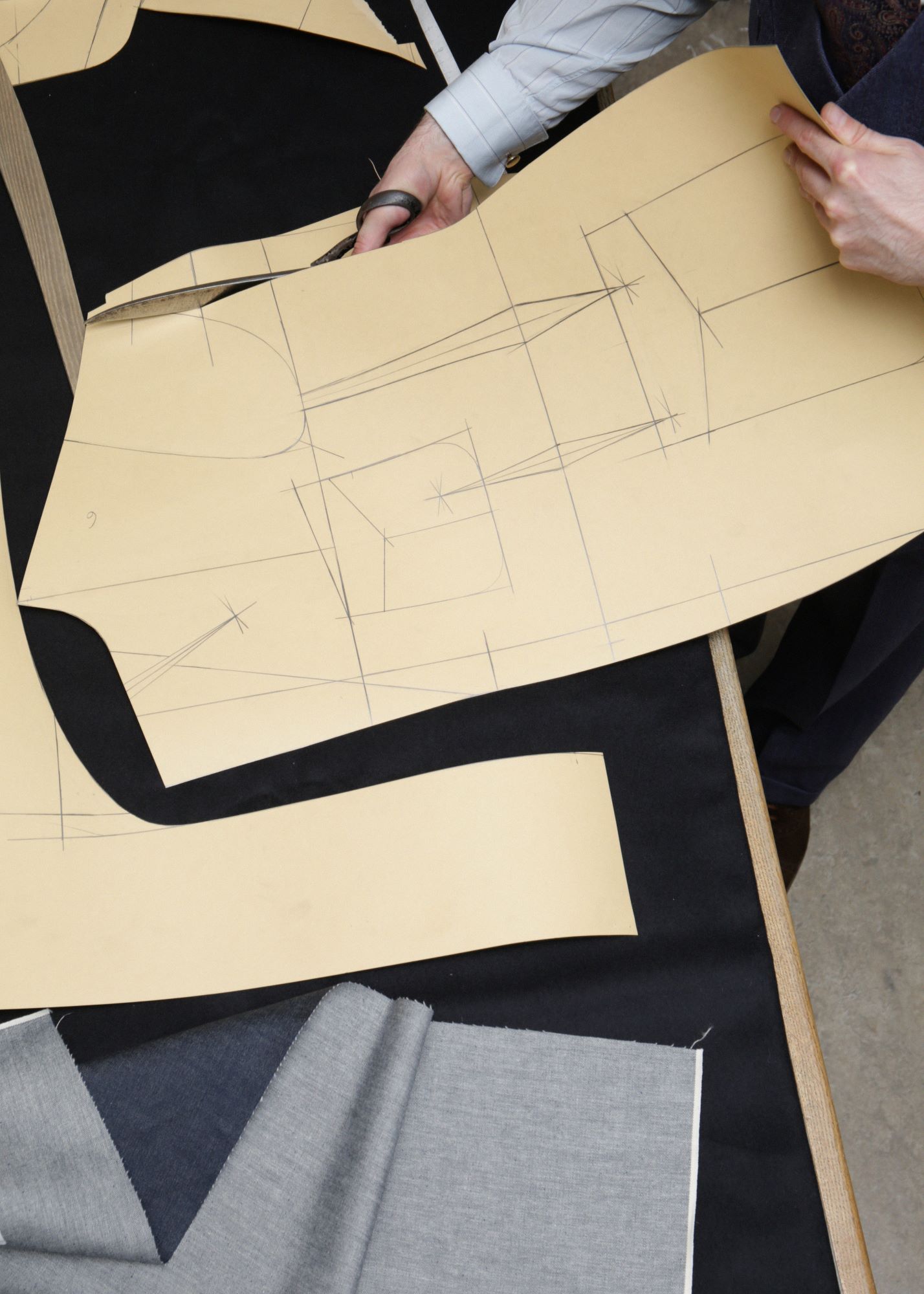
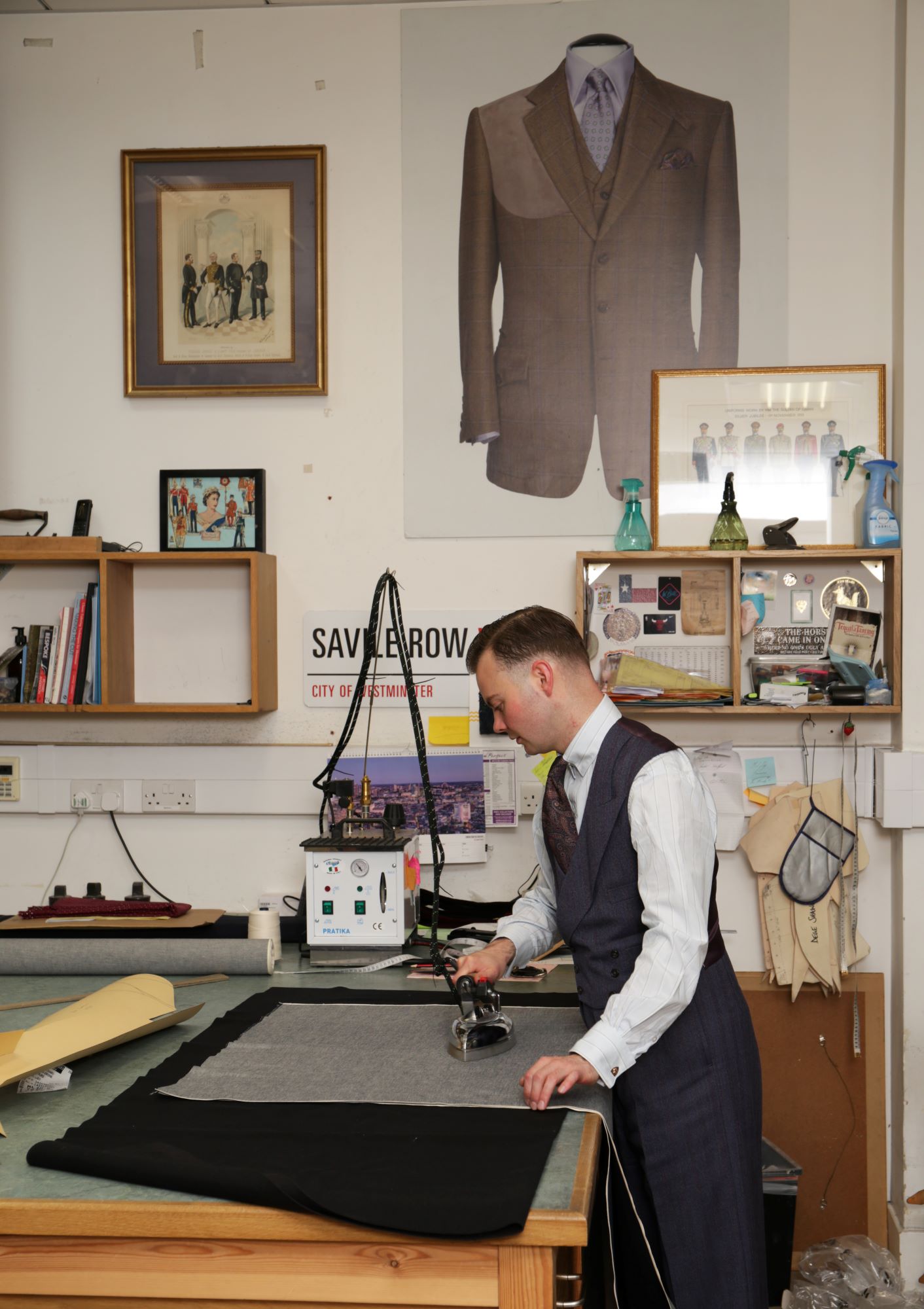
In the first part of the process, the blazer is cut for the editor-in-chief of Men’s File (shown here) and is inspired by traditional English style. The entire job is carried out by bespoke-cutter Alex Hills, who handles the design, measurement, and cutting. This meticulous process can take up to 40 hours to produce the finished item. Based in Tokyo, but with global distribution, Men’s File will feature the process of making and cutting over two issues (32 and 33).
Once again, denim proves to be a versatile fabric that has evolved from its workwear origins to claim its place in the realm of luxury. We believe our selvedge denim is the perfect tribute to the remarkable history of Dege & Skinner. While this denim represents the most classic type, it has been reinvented with our progressive innovations.
Selvedge denim is traditionally produced on shuttle looms, which are the most authentic type. However, these looms have largely been replaced by more efficient full-width looms in the mass production of denim. We take pride in preserving the authenticity and heritage of selvedge denim fabrics. Typically characterized by a white band accented with colored stitching, these fabrics can now feature a wide range of colors and constructions. We blend this traditional style with sustainable innovations.
Our fabrics reflect the classic appearance and character of selvedge denim while also integrating special fibers and yarns, innovative dyeing techniques, and patented technologies. As a result, they offer unique sustainability benefits that address contemporary challenges.