 Log into your account
 Register



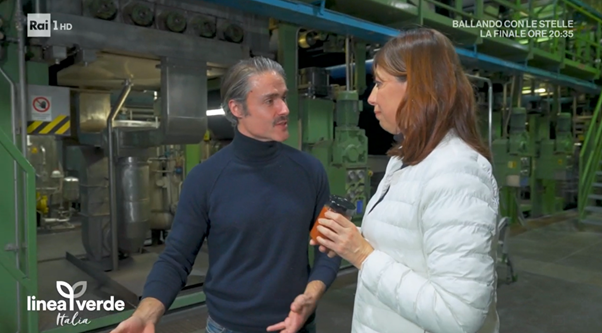
Candiani played a significant role in the Milan-focused episode of Linea Verde Italia. This Rai1 program, hosted by Elisa Isoardi and Monica Caradonna, explored the city’s commitment to a more sustainable future by highlighting some of its most impressive initiatives.
Milan: balancing urban renewal and environmental protection
The episode, produced in collaboration with the Ministry of Environment and Energy Security, focused on Milan’s commitment to culture, urban renewal, environmental protection, and energy transition. Elisa Isoardi and Monica Caradonna guided viewers through Milan’s stunning architecture, rich historical heritage, and emerging sustainability challenges, illustrating a city where the well-being of its citizens is at the forefront of urban redevelopment and improved mobility initiatives.
The journey began at the iconic Castello Sforzesco and continued to Porta Nuova park, where innovative technology allows trees to communicate their health and measure the surrounding environmental conditions. The team also visited the construction site of the futuristic CityWave building, which is powered entirely by renewable energy, as well as the city’s archive center.
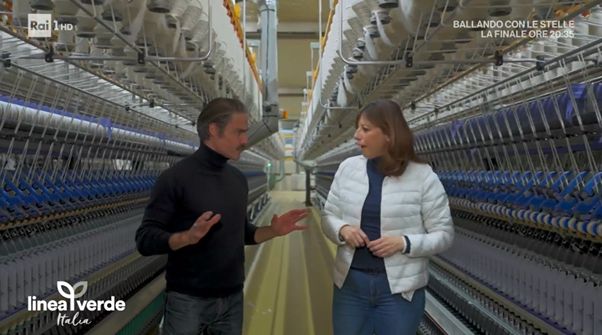
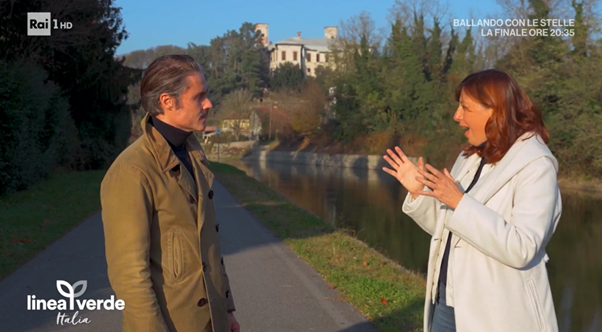
Finally, the Linea Verde Italia team traveled approximately 40 kilometers from the center of Milan to Castelletto di Cuggiono and then to Robecchetto con Induno, where they visited Candiani’s headquarters. Here, they observed how raw materials are transformed into denim fabrics that are compostable and can safely return to nature at the end of their life cycle. The episode concluded with a breathtaking view of Milan’s skyline from the terrace of the Duomo.
Candiani’s journey with Linea Verde Italia
Simon Giuliani, the marketing director at Candiani, guided Monica Caradonna through the company’s history and its patented COREVA™ technology, which is used to create the world’s first plastic-free and compostable stretch denim.
Candiani is committed to the 3R principle—reduce, reuse, recycle—and its location within the protected natural area of Ticino Park further influences its practices. The company focuses on developing technologies that reduce water consumption in denim production and employs improved cotton varieties that surpass conventional industrial options.
One of Candiani’s primary goals is to minimize the environmental impact of stretch jeans, which currently dominate the denim market. Traditional elastic yarns take hundreds of years to decompose and release microplastics.
Simon explained that COREVA™ technology was inspired by the elastic rubber nets used to wrap salami. This innovative technology replaces traditional elastic yarns with natural rubber and has applications that extend beyond the denim sector. For instance, tomato sauce made from COREVA™ fabric scraps was used by Elisa Isoardi and chef Cesare Battisti to enhance mondeghili, a popular Milanese dish.
The entire episode is available on RaiPlay.