
 Log into your account
 Register



As demand for ethical fashion grows, so does greenwashing—when brands exaggerate or fake eco-friendly claims to appear sustainable. In the battle of greenwashing vs sustainability, knowing the difference is key. This article breaks down what greenwashing is, how to spot it, and why it’s especially common in fashion. Plus, our sustainable denim guide will help you identify how brands and manufacturers back up their claims with real action—not just clever marketing.
What is greenwashing?
Greenwashing is a deceptive marketing practice in which a company or organization exaggerates or falsely claims to be environmentally friendly to attract eco-conscious consumers or enhance its public image. This practice, whether intentional or not, is significant because it can mislead consumers into supporting unsustainable businesses, undermine genuinely sustainable companies, and hinder real progress toward environmental goals.
Environmental activist Jay Westerveld coined the term “greenwashing” in the 1980s after staying at a hotel in Fiji that encouraged guests to reuse their towels to reduce water consumption and limit the release of detergents into the environment. Westerveld observed that while this initiative appeared environmentally friendly, it actually masked a more significant negative impact on the planet. He noted the owner’s opportunism, as the practice would lead to substantial cost savings, while the hotel showed no commitment to environmental efforts elsewhere on the property.
The fashion industry, in particular, is under scrutiny for its substantial environmental impact. Raw material extraction, lengthy supply chains, and energy-intensive production processes contribute to the sector being responsible for 2% to 8% of global carbon emissions. For context, the shipping and aviation industries combined account for about 5% of global emissions.
Despite increasing consumer awareness and significant efforts to reduce pollution, greenwashing remains a challenge in the fashion industry. The United Nations highlighted a recent study showing that 60% of sustainability claims made by European fashion giants are “unsubstantiated” and “misleading.” This situation has led to confusion among consumers and growing mistrust regarding what is genuinely sustainable.
Common tactics to watch
Greenwashing can take various forms, some of which are more obvious than others. The UN listed some of the most common tactics, which include:
- Claiming to be on track to achieve net-zero emissions without a credible plan
- Using vague or non-specific language regarding a company’s operations or the materials it uses
- Misleading labels such as “green” or “eco-friendly” lack standard definitions and can easily be misinterpreted
- Suggesting that a minor improvement has a major impact or promoting a product that only meets minimum regulatory requirements as if it offers significant benefits
- Highlighting a single environmental feature while ignoring other harmful effects
- Claiming to avoid illegal or non-standard practices that are irrelevant to the product
- Presenting the sustainability features of a product in isolation from the brand’s overall activities—for instance, advertising a garment made from recycled materials while it is produced in a factory that emits high levels of pollution and contaminates local waterways
Other common tactics can include:
- Making claims without providing transparent data, lifecycle analysis, or recognized environmental certifications
- Advertising an environmentally harmful product as being more eco-friendly than its competitors
- Using green colors, nature imagery, or fabricated eco-seals to create a false impression of environmental friendliness
- Promoting one "green" product while the company as a whole continues unsustainable practices
Proof of real sustainability
In the context of widespread greenwashing practices, it’s important to understand how to identify real eco-fashion. Effectively communicating sustainability can be challenging, as real impacts are often difficult to measure.
Here are some indicators of genuine sustainability:
- Transparent reporting: companies should openly publish comprehensive reports detailing their environmental impact, including both successes and challenges. These reports should contain data and specific metrics
- Third-party certifications: look for reputable certifications that indicate products or practices meet established sustainability standards
- Scientific verification: companies should support their claims with scientific evidence. This may include conducting thorough lifecycle analyses to evaluate the environmental impact of their products or using recognized accounting methods, such as the Greenhouse Gas (GHG) protocol, to validate claims about net-zero emissions
- Holistic approach: true sustainability involves considering the entire lifecycle of a product or business, from sourcing materials to end-of-life disposal, rather than focusing on one aspect alone
- Specific and measurable goals: companies should establish clear and quantifiable short-, mid-, and long-term goals for improvement, such as committing to reduce carbon emissions by a certain percentage, and begin implementing these goals immediately
- Continuous improvement: sustainability is an ongoing process. Companies should demonstrate a commitment to learning, adapting, and enhancing their practices over time
- Advocacy for systemic change: companies can show a deeper commitment by advocating for broader policy changes that support environmental sustainability
- Workforce training and education: employees should be educated on the importance of genuine sustainability efforts and the risks associated with greenwashing. Fostering a culture of sustainability within the organization is crucial for ensuring real commitment and credibility
- Stakeholder engagement: all stakeholders—including employees, governance bodies, customers, investors, and regulators—should be involved in the sustainability journey, with mechanisms for feedback and accountability in place
How Candiani validates its claims
We are committed to transparency and actively work to avoid greenwashing by supporting our claims with solid evidence and collaborating with trusted partners. Each year, we publish a sustainability report by the guidelines set forth by the Global Reporting Initiative. We also monitor our supply chain through second-party audits, investing in expert consultants and training our internal auditors. Our primary focus is on obtaining certifications, conducting tests, and performing lifecycle assessments (LCAs). Here are some concrete examples of our efforts.
We have achieved several voluntary process- and product-related certifications, ensuring that our practices align with our sustainability goals. These certifications confirm that we utilize organic, regenerative, and recycled fibers, avoid harmful chemicals, and adhere to social responsibility and ethical working standards.
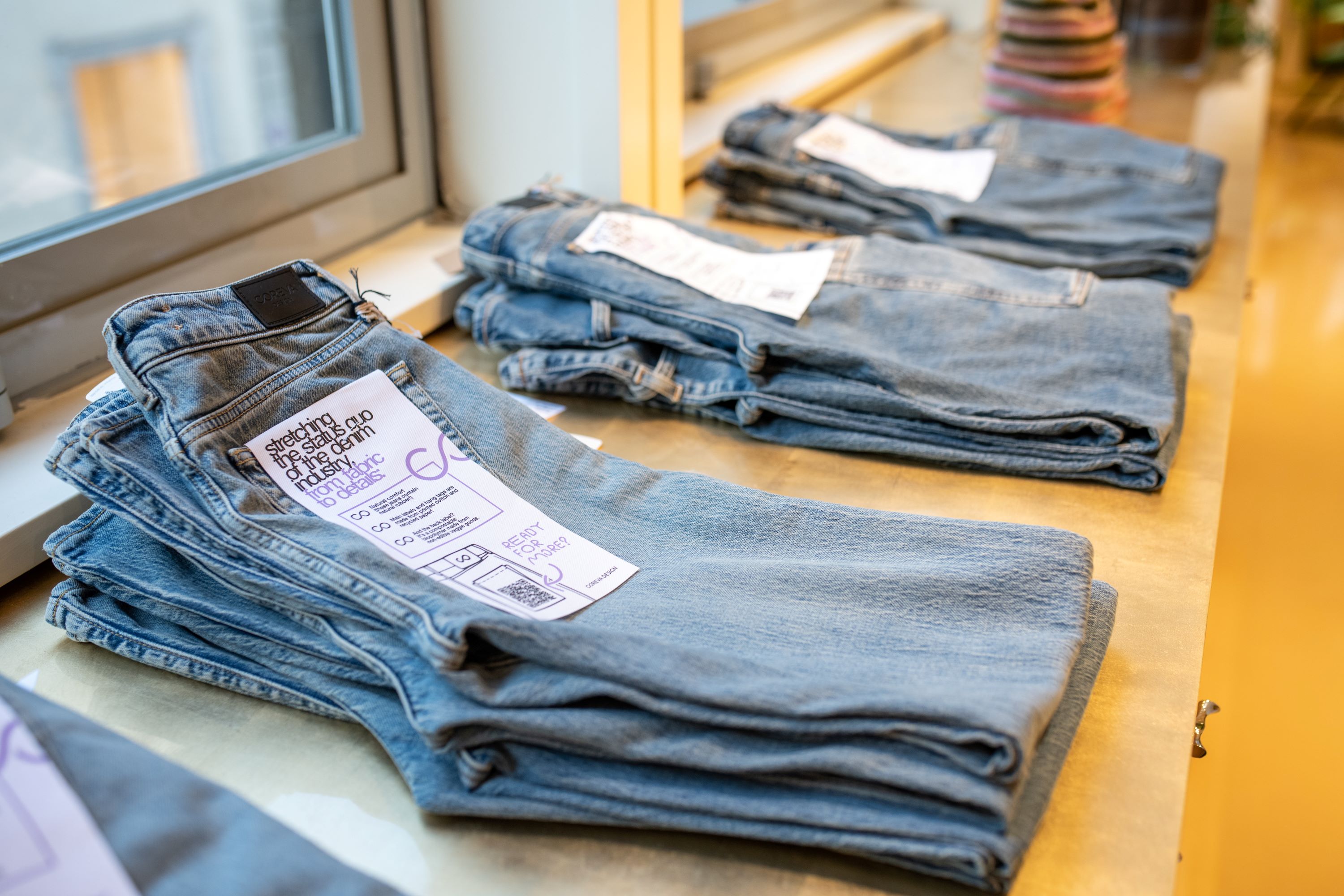
Additionally, our patented COREVA™ stretch technology, creating the world’s first plastic-free and compostable stretch denim, was tested multiple times to assess its impact. Tests with Innovhub found that after 12 weeks, 98.1% of COREVA™ decomposed without environmental harm, and seeds from mung beans and barley planted in the compost thrived. In collaboration with the Rodale Institute California Organic Center, we used COREVA™ fabric scraps to cultivate our Blue Seed cotton, showing improved soil respiration and moisture. Tests with Quintosapore in Umbria on tomato plants indicated that COREVA™ offcuts did not significantly change the soil’s chemical composition and helped retain moisture.
Finally, we performed an LCA to evaluate the impact of our post-consumer recycled denim, measuring factors like air pollution and endpoints related to human health and ecosystems. Backed by MUSA (Multilayered Urban Sustainability Action), our collaborative project aims to establish a model for public-private partnerships focused on sustainability, significantly reducing environmental impacts compared to standard denim production.