 Log into your account
 Register



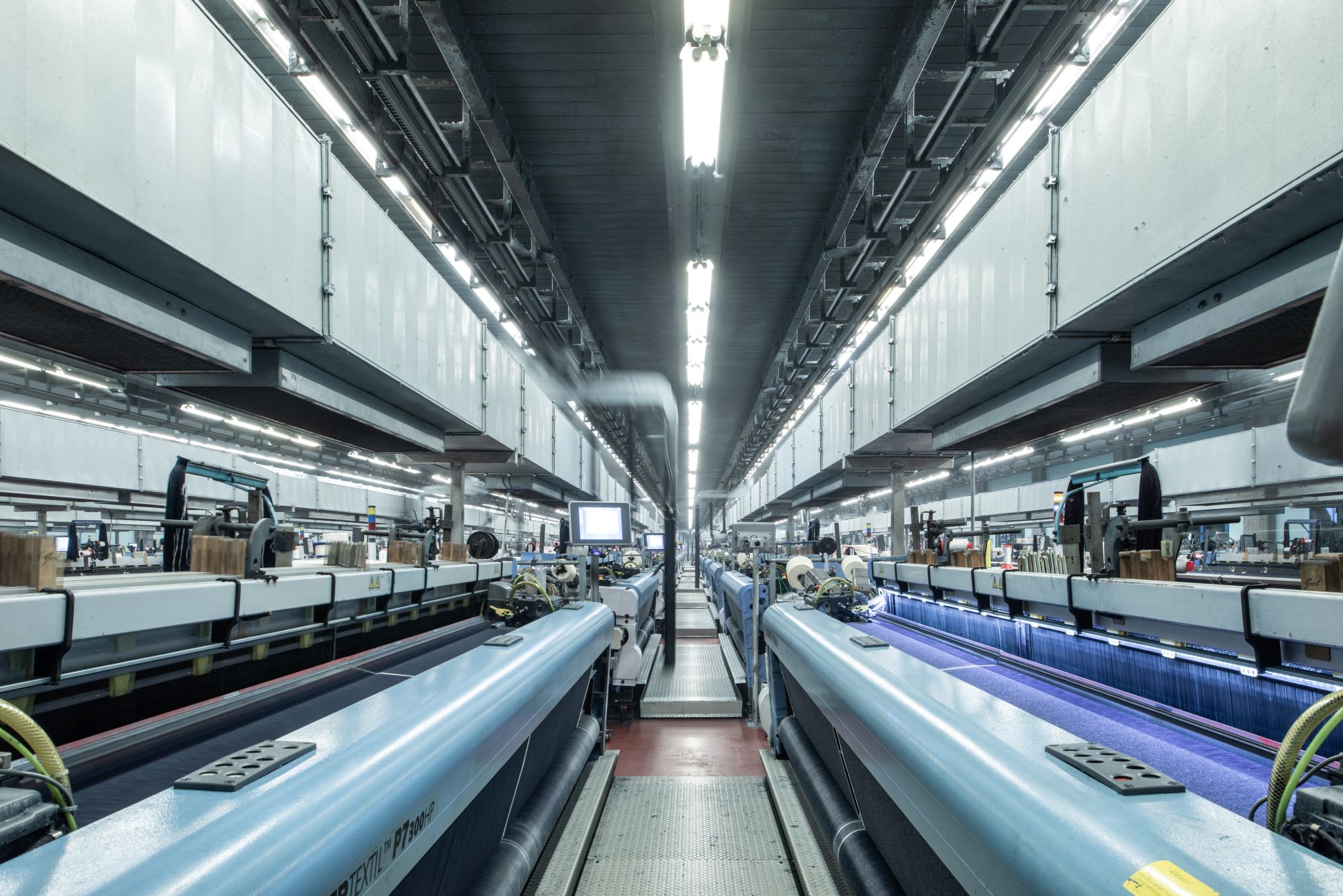
When it comes to how denim fabric is made, weaving plays a pivotal role. During the Middle Ages, weaving evolved into a true art form, with specialized centers emerging across Europe and guilds established to safeguard their expertise. Today, traditional weaving techniques are combined with modern machinery and innovative designs, giving denim a contemporary flair while preserving its authentic character.
Twill weaving explained
Twill is a weaving technique that creates a distinctive diagonal pattern on the fabric’s surface. It is traditionally known for its durability and strength, making it suitable for both casual and workwear. Twill can be used to create various types of fabric, including denim. However, it’s important to note that while denim is generally a type of twill, not all twill is denim; denim represents a specific kind of cotton twill fabric.
The term “twill” originates from the Old English word “twili,” derived from the Latin “bilix,” meaning “with a double thread.” Variants of the term include the Middle English “twile” and “twilly,” as well as the Scottish and Northern English term “twyll.” All these names referred to cloth woven in parallel diagonal lines, indicating the double-thread technique.
The diagonal lines in twill fabric are created by intertwining the warp (vertical) and weft (horizontal) threads on the loom. Because of this construction, twill fabrics have a front and a back, depending on which threads are more prominent on each side. The front side features the most pronounced diagonal pattern, making it the more attractive side and the one visible during weaving.
Traditionally, denim uses a 3x1 right-hand twill construction, meaning there are three warp yarns for every weft yarn on the front side. The warp yarns are typically dyed with indigo, while the weft yarns remain the natural color of cotton. The term “right-hand” indicates that the twill lines run from the bottom left to the top right on the face of the fabric. Although this is the classic denim construction, many other alternatives are now used in the industry.
Traditional denim looms
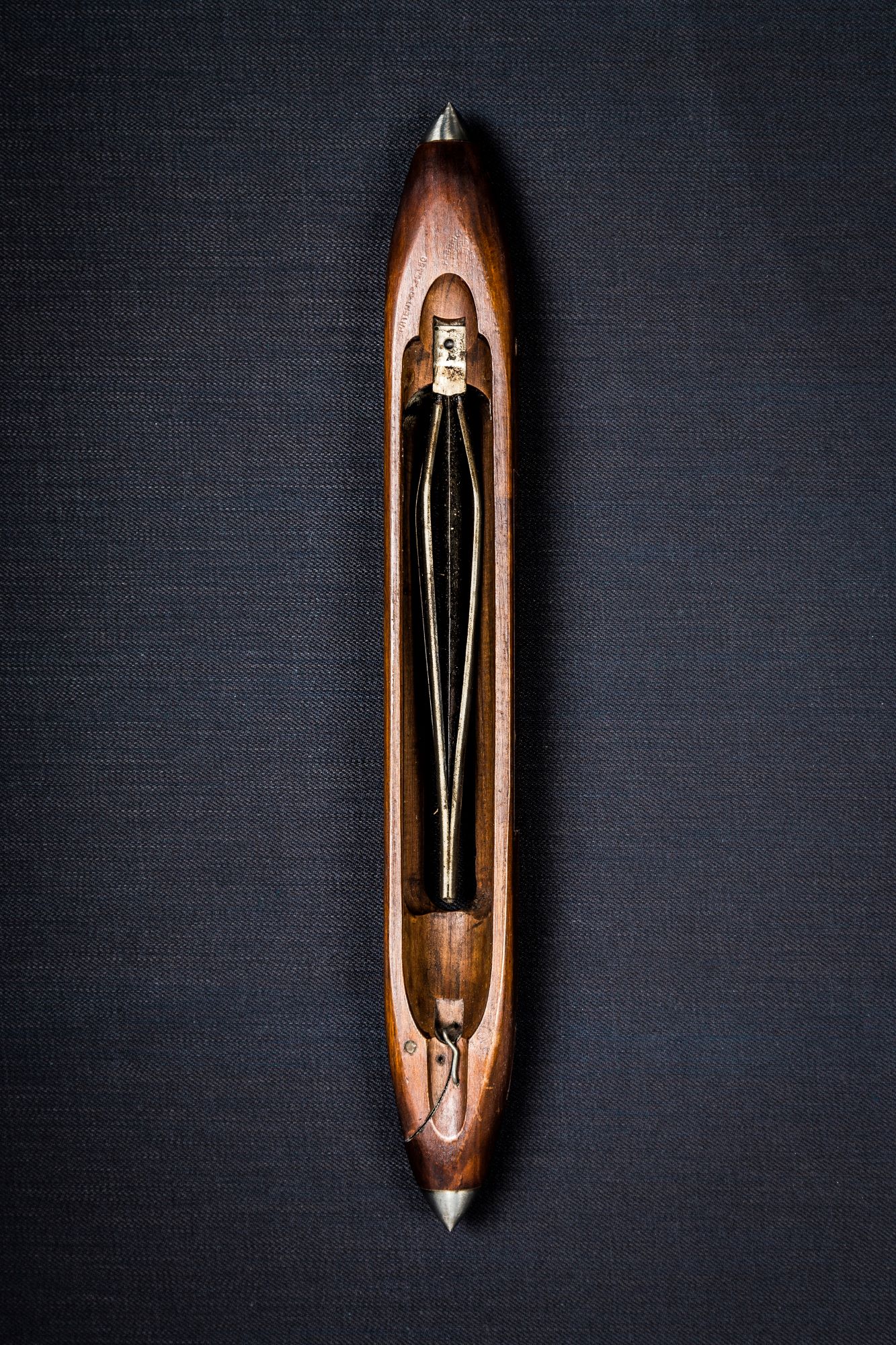
Denim was originally produced on shuttle looms. In this process, warp yarns are set in the loom, while a shuttle carrying the weft thread moves horizontally, weaving it with the warp to create the fabric. The shuttle makes numerous continuous passes back and forth with the same weft yarn, which forms what is known as selvedge.
Selvedge denim features a distinct, thicker border that is usually a different color from the rest of the fabric. Typically, this border is a white band with colored stitching in the middle. However, it can now come in various colors and constructions. The term “selvedge” comes from “self-edge,” referring to its original purpose of preventing fabrics from fraying.
Leonardo da Vinci first sketched an automatic shuttle in 1495, but it was John Kay who patented the flying shuttle in 1733 during the Industrial Revolution in England. This innovative loom featured a paddle that automatically moved the shuttle, significantly speeding up the weaving process and enabling the production of larger fabric pieces.
Shuttle looms were the industry standard until the demand for denim surged during the economic boom. As a result, selvedge denim has become quite rare in the industry, as shuttle looms were largely replaced by more efficient machines that changed the denim-weaving process. However, selvedge fabrics are highly sought after by denim enthusiasts, as they symbolize tradition and authenticity.
Modern denim production
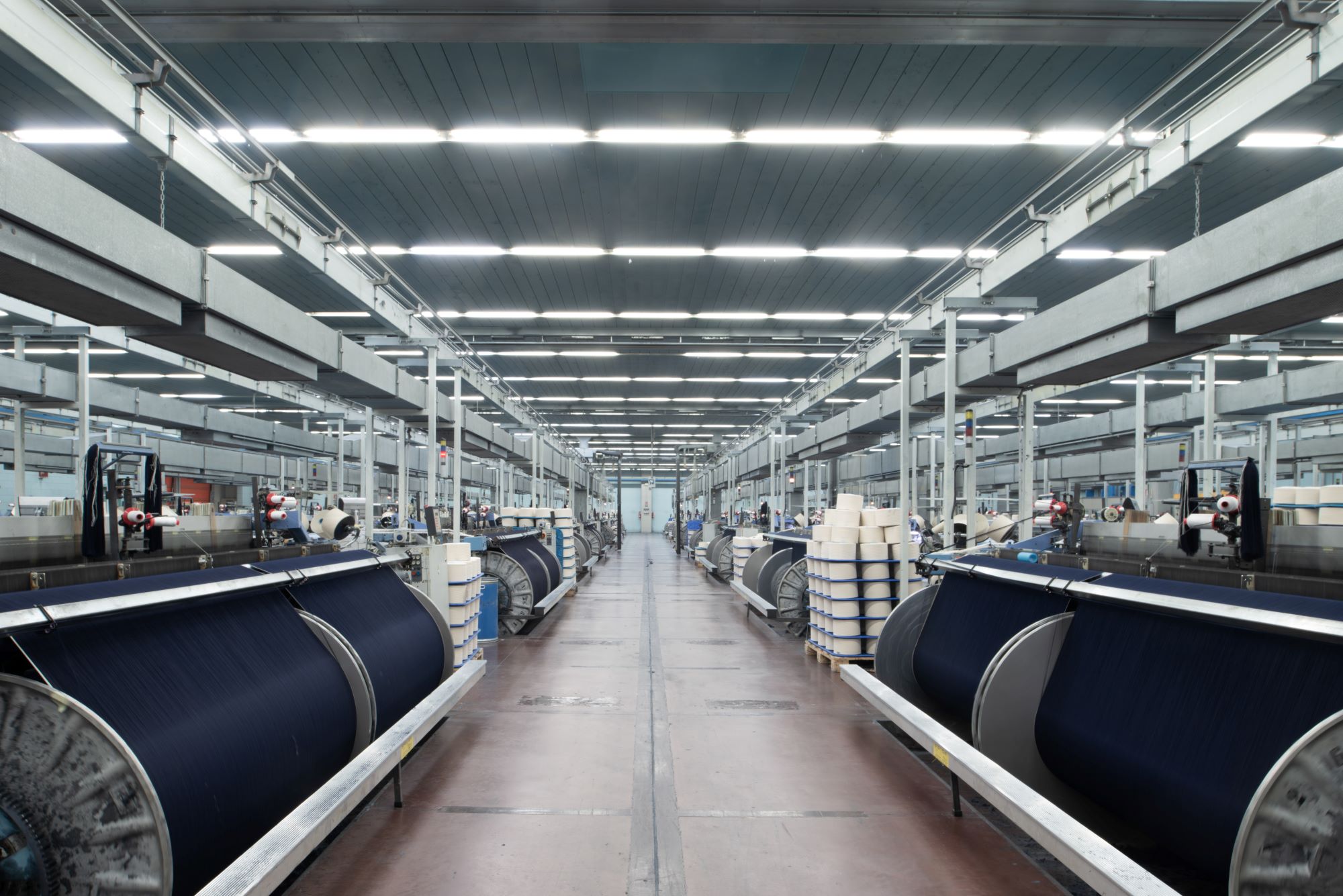
Full-width looms—typically projectile, rapier, or air-jet machines—were introduced to accelerate the denim-weaving process and create larger, more uniform fabrics for mass-produced standard jeans. At Candiani, we exclusively use projectile looms. Plus, we still have vintage shuttle looms to preserve the tradition of selvedge denim.
In this type of loom, warp yarns are still set while multiple small projectiles grip the end of the weft yarn and shoot it across the warp threads. Once a projectile reaches the opposite side, it releases the yarn and drops down onto a conveyor belt, which then returns the projectile while another one shoots across the loom. Because the projectiles don’t return with the weft yarn, the weft is cut at the edges of the fabric, leaving frayed, unfinished ends.
Although shuttle looms are often associated with higher-quality fabric production, this is not entirely accurate. Quality is not solely linked to the type of denim loom; it also depends on the entire manufacturing process, beginning with the type of cotton used. The misconception that full-width looms are inferior stems from their introduction alongside mass production, which prioritized high volume over fine fabrics. Initially, shuttle looms were used to make workwear fabrics when blue jeans emerged in the late 19th century. In the last few decades, selvedge denim has become a niche product, as shuttle looms are no longer produced; however, it has recently experienced a revival driven by renewed interest in heritage clothing.
Fabric innovation
From a design perspective, fabric innovation in the denim-weaving process can involve various elements such as construction, color, and density. The most traditional denim construction is a 3x1 right-hand twill. This means that the diagonal lines on the front side of the fabric run to the right, with three warp yarns for every one weft thread. However, other constructions have become common, such as 2x1 twill for lightweight fabrics, broken twill, which creates a zigzag pattern, and left-hand twill, typically found in softer fabrics.
The color of the weft is also crucial in determining the fabric’s appearance. Ecru is the most conventional choice, but monochromatic fabrics with a dark weft are popular, especially for workwear-inspired garments. For a vintage aesthetic, beige or melange yarns can be used, while recycled threads provide denim with a distinctive indigo-greyish weft.
Additionally, denim can feature either an open weave or a more compact construction, depending on the weave density. Open weaves help achieve a vintage look while accentuating denim’s character, whereas compact weaves produce more uniform fabrics.
Finally, fabric innovation must consider the environmental impact of the production process. In the weaving sector, this primarily involves energy efficiency and reducing emissions, with technology continually evolving to enhance energy savings and decrease consumption. At Candiani, we replaced outdated motors in 2014 and transitioned from rapier looms to energy-efficient projectile looms in 2016.